PG Certification In Data Science

In our data-driven and technological age, businesses are looking to utilize these technological advancements
in the day to day work and looking for individuals with a robust understanding
of data science as they are more valuable than ever.

Course description

About the Course

Masters to PG in Data Science from The Scholar is designed for students with all levels of experience and for Freshers, equipping learners for a wide variety of interesting and in-demand careers. Gain specific, marketable skills in the top coding languages, along with critical knowledge in Data Science standard programming using Python, mathematics, statistics, data analysis, and machine learning. 

This program is designed by Industry professionals and give learners end to end understanding of the real world scenarios which will help the learners to gain the best knowledge add they can apply in the job while working.

The Complete Program will Have 150+ Hrs. of Live Training + 150+ Hrs. of Working on Assignments & Case Study .

Eligibility

Who Can Join & What to Expect in Class

Eligibility

Assignments, Videos & Case Studies

Course Roadmap – Built Just for You

Introduction to Data Warehouse

Facts and Dimensions

Normal Forms
Introduction to constraints – Part 1
Introduction to constraints – Part 2
Types of SQL Commands
Operators and Clauses
Single Row Function – Part 1
Single Row Function – Part 2

Multi Row Function

Joins in SQL – Part 1
Joins in SQL – Part 2
Joins in SQL – Part 3
Single Row SubQuery
Multiple Rows SubQuery
Multiple Column Sub Queries
Exists and With Clauses

Set Operators in SQL

Data Manipulation

Views in SQL

Sequences, Synonyms and Index
Alter Statements in SQL

Multi table inserts

Merge in SQL
Hierarchical Data fetching
Regular Expressions
Analytics Functions – Part 1
Analytics Functions – Part 2
Materialized Views
SQL Interview Prep – Advanced Select
SQL Interview Prep – Joins
Basics of Python (Python History and Features)
Basics of Python (Data Types Part 1)
Basics of Python (Data Types Part 2)
Basics of Python (Lists in Python)
Detailed explanation of Lists and its functions
Basics of Python (Tuples, Dictionaries and Sets)
Detailed explanation of Tuples, Dictionaries and Sets
Input ways in Python
Input statement
Flow Control – Part 1

Flow Control – Part 2

String Operations in Python
String Operations in Python – More Examples
Functions in Python – Part 1
Functions in Python – Part 2
Functions in Python – Part 3
Exception Handling – Part 1
Exception Handling – Part 2
Exception Handling – Example

File Handling – Part 1

File Handling – Part 2
Binary files
Regular Expressions – Part 1
Introduction to OOPs

Object Oriented Programming – Part 2

Object Oriented Programming – Part 3
Object Oriented Programming – Part 5
Object Oriented Programming – Part 6
Object Oriented Programming – Part 7
Object Oriented Programming – Part 8
Object Oriented Programming – Part 9

Object Oriented Programming – Part 10

Object Oriented Programming – Part 11

Numpy – Part 1

Numpy – Part 2
Numpy – Part 3

Pandas – Part 1

Pandas – Part 2

Pandas – Part 3

Pandas – Part 4

Pandas – Part 5

dfply understanding

Data Visualization of Matplotlib

Data Visualization of Seaborn
Data Preprocessing using SKLearn- Missing Value Imputation
Data Preprocessing using SKLearn – Outlier Treatment

Data Preprocessing using SKLearn – Feature Scaling – Theory

Data Preprocessing using SKLearn – Feature Scaling – Handson
Python connection with Oracle – Part 1
Python connection with Oracle – Part 2

Exploratory Data Analysis – Part 1

Exploratory Data Analysis – Part 2

Tableau – An introduction

Tableau – Creating first chart

Tableau – Data from Heterogeneous data sources
Tableau – Data Blending in Tableausources

Tableau – Bins, Parameters and creating our first dashboard

Tableau – Dashboard and Story
Tableau – Time series analysis
Tableau – Sets and Parameters for more dynamic visualization

Tableau – Combined Sets and Formatting of the visuals

Tableau – Animation in Tableau – Data Prep

Tableau – Animation in Tableau – Visualization
Tableau – Level of Details (Include)

Tableau – Level of Details (Include and Exclude)

Tableau – Level of Details (Fixed)

Tableau – Level of Details (Real time use cases)

Tableau – Table Calculation – Data Prep Part 1

Tableau – Table Calculation – Data Prep Part 2

Tableau – Table Calculation – Functions Part 1

Tableau – Table Calculation – Functions Part 2

Creating the logic for Quality assurance in the output
Statistics – An Introduction
Measure of Central Tendency
Measure of Spread – Part 1  
Measure of Spread – Part 2
Regression – Part 1
Regression – Part 2.1
Regression – Part 2.2
Regression – Part 2.3  
Regression – Part 3
Regression – Part 4
Normal Distribution – Part 1
Normal Distribution – Part 2  
Normal Distribution – Part 3
Symmetric Distribution, Skewness, Kurtosis and KDE
Probability – An Introduction
Probability – Part 2
Probability – Part 3.1
Probability – Part 3.2
Permutations and Combinations

Random Variables

Random Variables Variance

Binomial Distribution – Part 1

Binomial Distribution – Part 2
Geometric Random Variables – Part 1
Geometric Random Variables – Part 2
Poisson Distribution
Sampling Distributions
Central Limit Theorem
Confidence Interval
Margin of error
T-statistic
Significance Tests – An Introduction
Type 1 and Type 2 Erros
Constructing Hypothesis for a significance test about a proportion

More on Significance Testing

Comparing two proportions
Comparing two means
Introduction to Chi Squared Distribution
Chi Square Test for Homogeneity and Association
Advanced Regression
Anova and Fstatistic
Introduction to Python Introduction to Logistic Regression
Classification algorithms in varioussituations
Performance measurement ofmodels  
Supervised Machine Learning – Classification – Naive Bayes
Supervised Machine Learning – Classification – Logistic Regression
Supervised Machine Learning – Regression – Linear Regression  
Solving optimizationproblems
Supervised Machine Learning – Classification and Regression – Support Vector Machines (SVM)
Supervised Machine Learning – Classification and Regression – Decision Trees  
Unsupervised learning – Clustering – Kmeans  
Unsupervised learning – Clustering – Hierarchical clustering Technique
Unsupervised learning – Clustering – DBSCAN (Density based clustering)  
Association Rule Mining (Apriori)
Recommender Systems and Matrix Factorization  
Dimensionality reduction andVisualization
Principal ComponentAnalysis.  

T-distributed stochastic neighborhood embedding(t-SNE)
Introduction to Python
Introduction to Logistic Regression
Introduction to Artificial Neural Network  
Deep Multi-layer perceptrons  
Convolutional Neural Network  
Recurrent Neural Network

Program Fees

Enroll Like a Boss – Know the Costs

Program Fees

For Indian Residents

Rs.120000 + GST*

* Fee payable after Successful Placement

Rs. 40000 + GST*

For International Students

USD 5500

1st Installment will Start One Month Before the Commencement Date.
NO COST EMI at 8850/-* (24 Months)
(*NO COST EMI Subject to Approval)
* Loan option available in 6, 9 & 12 EMIs from loan partners.
* 1% + GST* processing fees will be charged by loan partner in 6/9/12 months EMI.

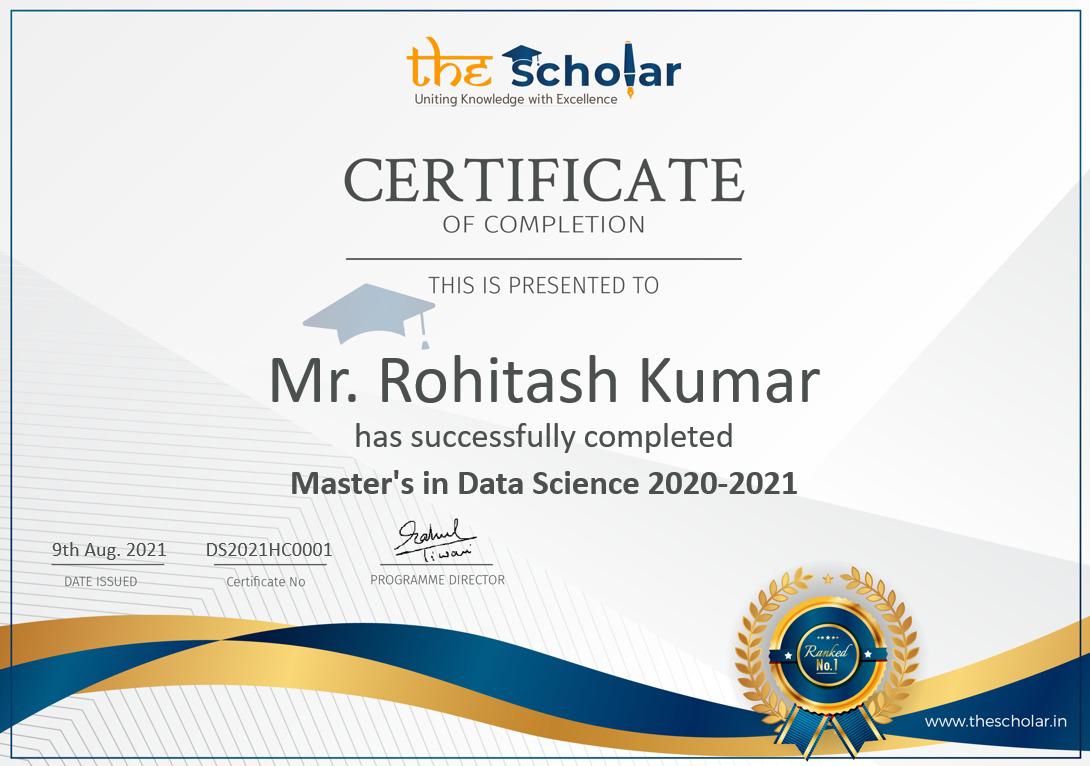
Course Certificate

Data Science Sample Certificate

Capstone Projects

Tools Covered

Our Mentors

Mr Rahul Tiwary

14+ Yr Exp. Professionals | Ex Deloitte | Ex Accenture | Ex Tech Mahindra

Mr Rakesh Sharma

14+ Yr Experience Professionals

Ritu Shukla

Sr. Data Analyst ( 8 + Yr Experienced Professional)

Alumni Speaks

Jagjit Hanspal Sr BI/ETL Consultant at Intact

Rahul was my Mentor for Tableau Certification Training. He has in depth knowledge in Read More

Mayur Korde

Behind the word mountains from the countries Vokalia and Consonantia, there live the blind. texts. Separated they.

Don Nachtwey Data Warehouse Analyst at GDIT ( Washington)

Rahul was my course instructor for Tableau. Read More

Kushal Pawar Scrum Master at Infosys

It gives me an immense pleasure to express my sincere gratitude to Rahul Read More

Accord

×

Live Consultation